
Imagine discovering a gold mine: Turkish funds promising returns of +70% per annum. Sounds like a dream? Yet without the right strategy, that dream can quickly turn into a financial nightmare. The Turkish market is not a sprint for easy money; it is a marathon through a minefield where your hard-currency capital is at stake.
The primary challenge for an expat investor is not merely finding a "rocket stock," but assembling a portfolio capable of withstanding the pressure of rampant inflation and the roller-coaster ride of the lira exchange rate. Let us examine how to avoid losing everything and emerge victorious.
Part 1. Three Horsemen of the Apocalypse for Your Portfolio
Ignoring these risks is a direct path to watching your US dollar gains evaporate, even if you become a millionaire on paper in Turkish lira.
1️⃣ Currency Risk: A David vs. Goliath Battle (TRY vs. USD)
Türkiye operates in a state of non-stop inflation. A lira-denominated fund may deliver a phenomenal +70% return over a year, but over the exact same period, the lira may depreciate so sharply that in US dollar terms you will break even at best. It resembles running up a downward-moving escalator.
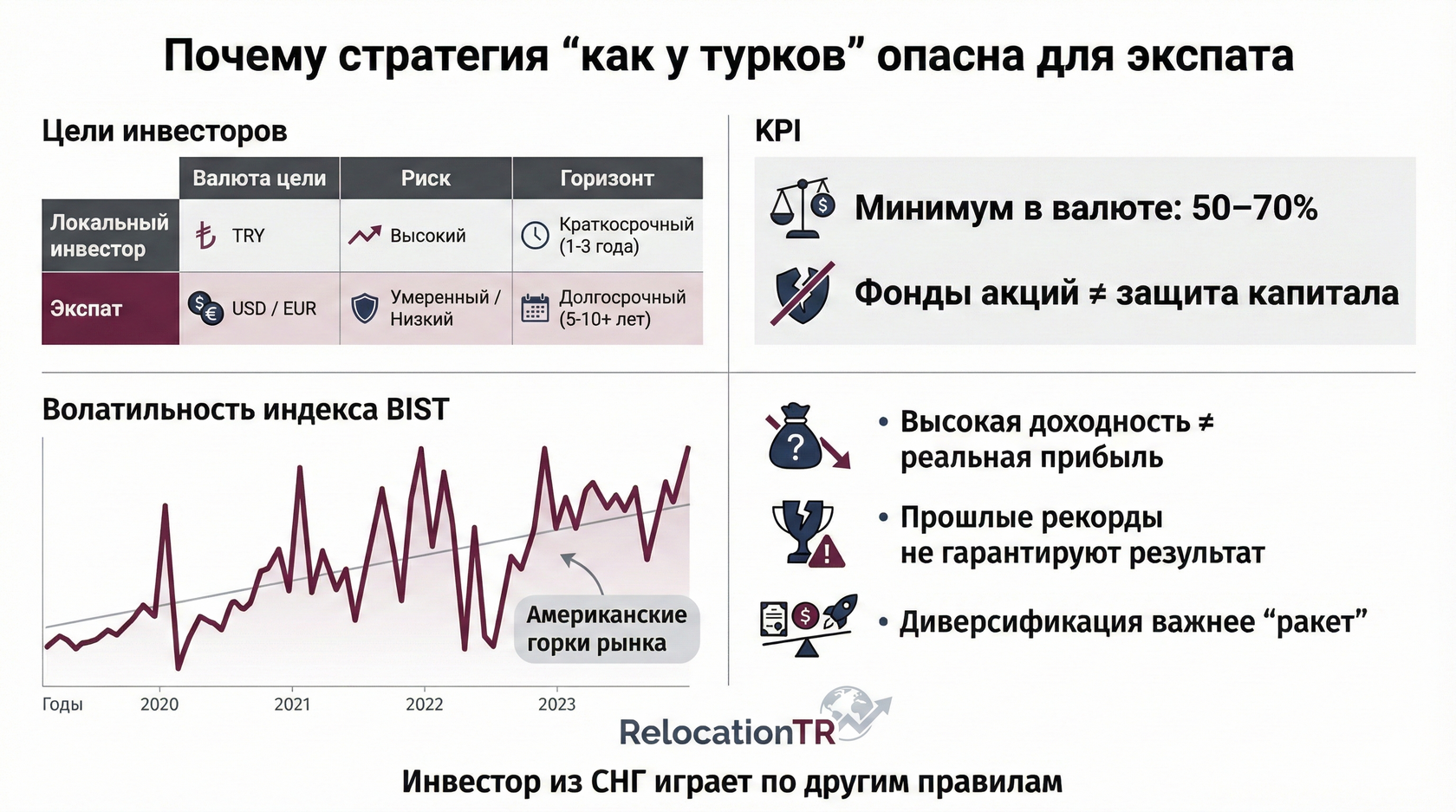
🛡 The Expat's Golden Rule: If your capital is denominated in USD or EUR, keep at least 50–70% of your portfolio in hard currencies. These can include FX-denominated instruments such as Eurobonds or foreign equities. The lira is for seasoning, not for the main course.
2️⃣ Market Volatility: A Roller-Coaster on BIST
Turkish equities launch like rockets, yet they plummet just as fast. A sharp policy rate shift by the central bank, political turbulence, or capital flight by foreign investors—and suddenly your portfolio is deeply in the red. Remember: what rises rapidly can fall just as swiftly.
🛡 Safety Rule: Equity funds are the growth engine of your portfolio, not its safety cushion. Never put all your eggs in this basket, regardless of how enticing it appears.
3️⃣ Regulatory Risk: When Rules Change Mid-Game
The Turkish Capital Markets Board (SPK) and the Central Bank can alter the rules of engagement at any moment without prior notice. New tax provisions, capital withdrawal restrictions, and abrupt compliance requirements are all intrinsic parts of the local landscape.
🛡 Prudence Rule: Work exclusively with heavyweight institutions—major licensed asset managers affiliated with banks boasting multi-decade track records. Avoid questionable boutique shops promising the moon.
Part 2. Why the Strategy of "Investing Like the Locals" Will Ruin You
Thinking like a domestic investor is an expat's cardinal mistake. Your objectives and risk exposures are fundamentally different.
❌ Do not copy the locals. Their primary objective is to outpace inflation in lira terms, because they spend in lira. Your objective is to compound capital in hard currency. These are two distinct universes.
❌ Do not chase triple-digit yields. Figures such as "+300% per annum" in Türkiye are most often a byproduct of inflation and currency devaluation, rather than portfolio manager brilliance. Yesterday's performance records do not guarantee tomorrow's gains.
✅ Your personal fund selection checklist:
1. Stress resistance: How does the fund behave during market drawdowns? Does it plunge faster than the benchmark, or does it absorb the shock?
2. Strategy: Is it a passive index tracker, or is it actively managed in an attempt to generate alpha and beat the market?
3. Currency balance: Does this allocation adhere to your rule of keeping at least 50% in hard currency?
Part 3. The "Major League": Whom Should You Bet On?
The Turkish market has its own standout asset management firms that have proven their reliability over decades. As a rule, these are asset management subsidiaries of the country's largest banking groups and premier investment houses.
Here is a shortlist of where to begin:
- Ak Portföy (subsidiary of Akbank)
- İş Portföy (the powerhouse of İşbank)
- QNB Portföy (part of QNB Finansbank)
- Yapı Kredi Portföy
- Garanti Portföy
- Tacirler Portföy
These names serve as your initial navigational landmarks in the Turkish investment landscape. Begin by reviewing their flagship mutual funds.
Analytical Conclusion by RelocationTR
The Turkish market is not a venue for fast money; it is a domain of strategy and discipline.
For an investor from the CIS, the key objective is not chasing maximum returns in lira, but preserving and growing capital in hard currency.
The winners are not those who chase soaring hype, but those who:
- manage foreign exchange risk,
- understand local regulatory and market nuances,
- diversify their holdings,
- partner with reliable institutional players.
#investing #turkishmarket #stockmarket #fxrisks #portfolio