
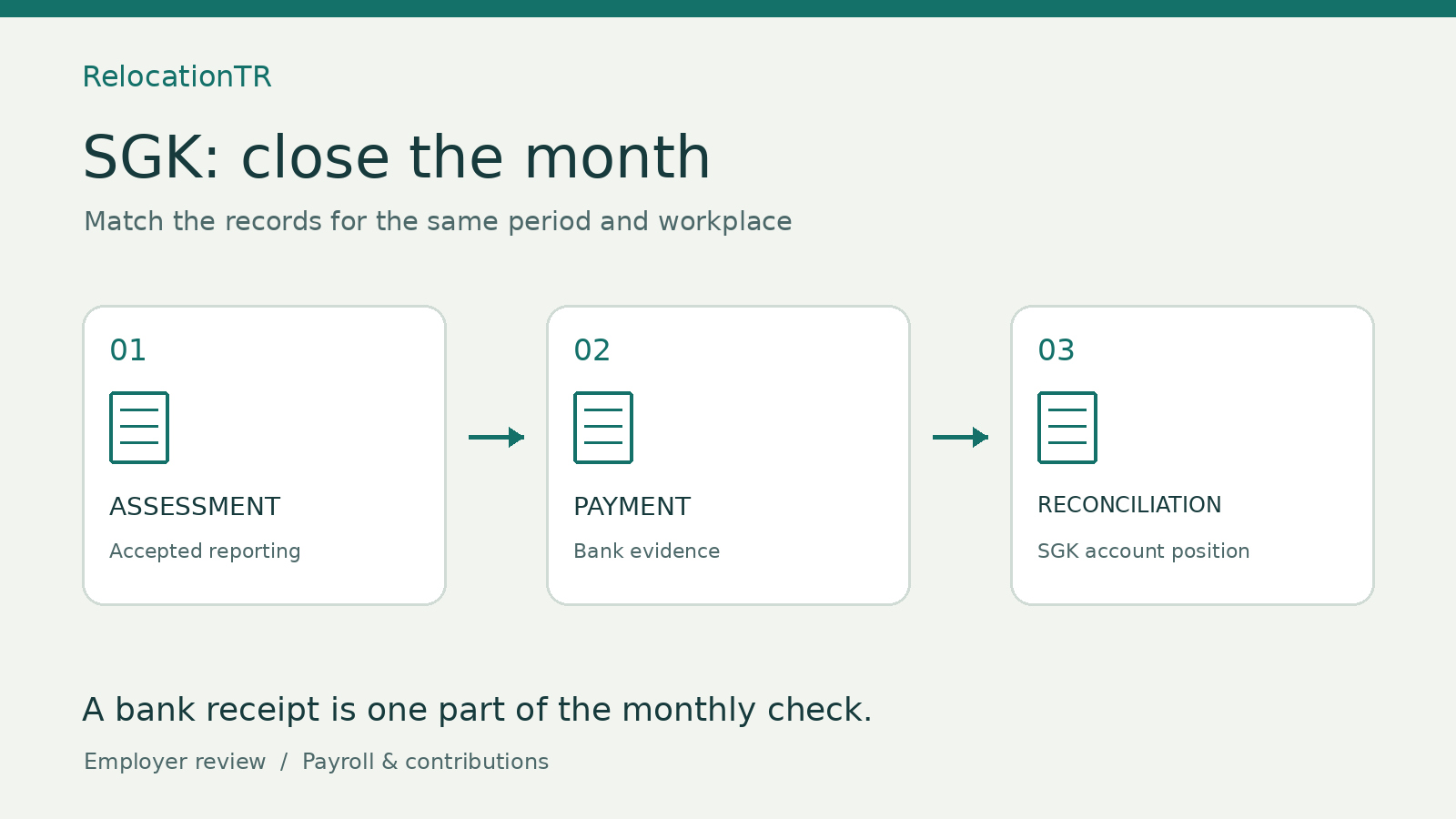
Paying salaries does not give a business owner a complete picture of the company's position with SGK, Türkiye's social security institution. The monthly review needs to connect payroll, accepted reporting, assessed contributions, payment evidence and the account position after payment.
Case: suppose a company in Türkiye pays its employees and receives a contribution spreadsheet from its accountant. If the owner receives only that spreadsheet, they cannot see whether the reporting was accepted or the money was credited against the intended liability. The next step is to collect matching records for the same month and workplace registration.
Agree the employee changes first
Before closing payroll, reconcile the employee list and changes during the month: starters, leavers, days worked, absences, leave, bonuses and corrections. Ask which events require a separate notification and when it is due. A monthly review cannot replace timely action when an event occurs.
Keep employee take-home pay, gross pay and total employer cost separate. The calculation should explain the employee contribution deduction and the employer's share. A generic percentage is not enough for a hiring budget without checking the employee category and applicable conditions.
Obtain evidence of accepted reporting
A payroll workbook shows the prepared calculation. To close the period, ask for evidence that reporting was accepted and the corresponding contribution assessment, known as tahakkuk. Match the period, workplace, employee records and totals.
The Muhtasar ve Prim Hizmet Beyannamesi, or MPHB, combines withholding and social security reporting. Tax assessments and SGK liabilities still need to be tracked separately. Ask the accountant to identify each payee, amount and payment entry in the cash calendar.
Match the payment to the SGK account
A bank receipt shows that a transfer was made. The review then needs to establish how it appears in the SGK account. SGK's official description of its employer services distinguishes period assessments and collections, and also identifies bank amounts that have not yet been matched against a liability.
If a balance remains after payment, request a written reconciliation showing the period, liability type, payment and reason for the difference. Before paying again, establish what the balance consists of and what happened to the first payment.
Close the month with a short register
| Review item | Evidence to retain | What the owner needs to understand |
|---|---|---|
| Employee data and changes | Agreed list and supporting records | Whether the calculation includes all relevant changes |
| Reporting and assessment | Acceptance evidence and tahakkuk | Which period and workplace the assessment covers |
| Payment | Bank receipt | The recipient, amount and liability paid |
| Account position | Current SGK reconciliation | Any remaining debt or unmatched amount |
| Open issues | Reason, owner and next action date | Who will resolve the discrepancy |
This is a suggested internal register, not a prescribed regulatory form. Restrict access to payroll and employee data to people who need it. The owner can receive a summary with controlled access to the supporting records.
Keep reporting and payment deadlines as separate entries. Have the accountant confirm the dates for the particular period, including the company's arrangements, public holidays and official extensions. A general guide should not become a substitute for the current calendar.
If the company needs an e-Borcu Yoktur no-debt document, check its date, purpose and scope. SGK provides a barcode verification service for the document. It can support the relevant procedure, but does not replace the monthly reconciliation of employee records, reporting and payments.
When changing accountants, hand over the last reconciled period, unresolved differences and upcoming deadlines. Assign someone inside the business to accept the monthly reconciliation. This gives the owner a usable record instead of leaving them to reconstruct the account position from messages when a debt appears.
Checked on 5 November 2026. This review is intended for routine employer administration involving employees; special worker categories and arrangements require separate checks.
Official sources: