
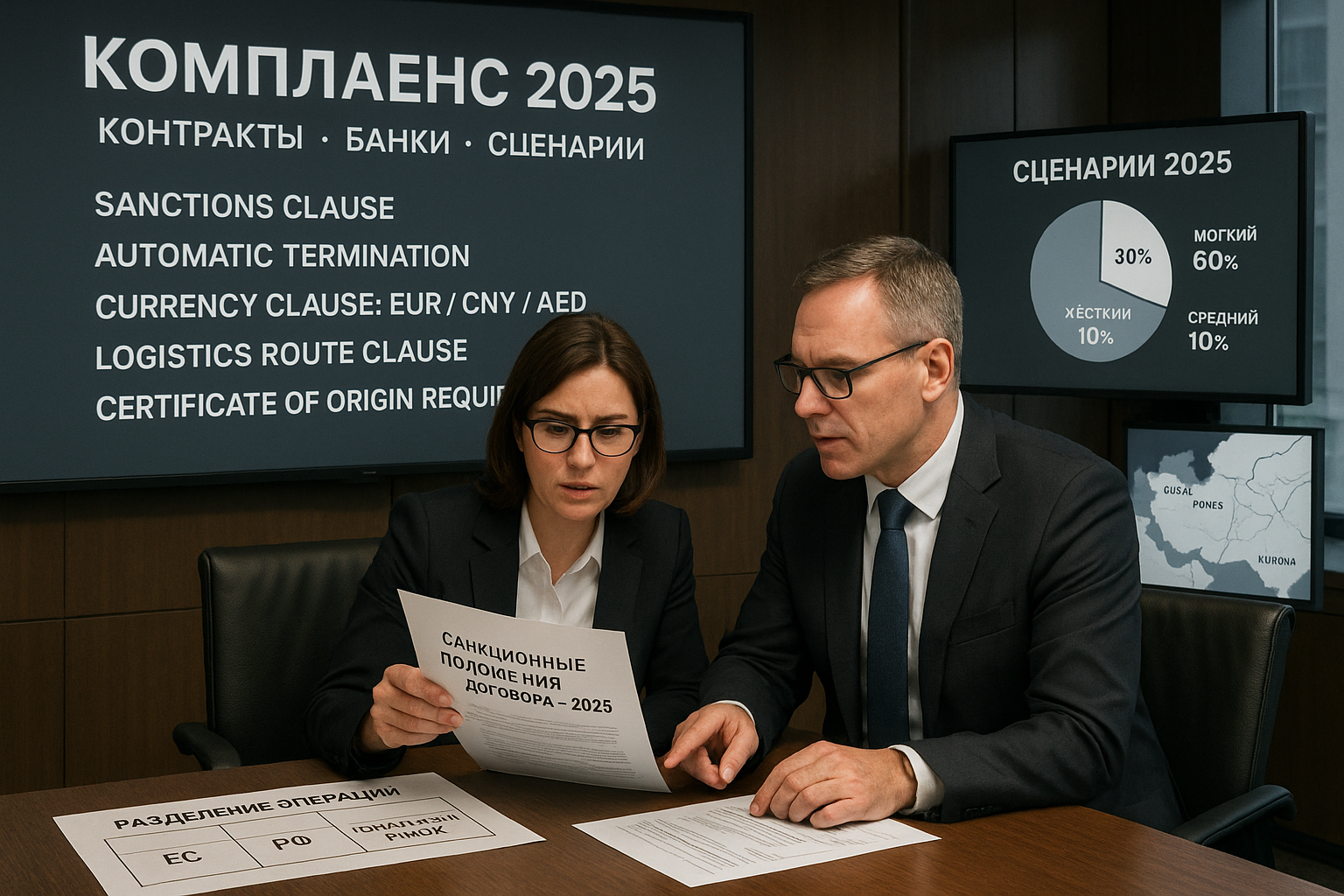
Practical Guide. Part 2: Contracts, Banks, Operations, and Scenarios
US secondary sanctions are compelling Turkish companies to shift from "intuitive risk management" to a systematic compliance model. This process requires discipline rather than panic: thorough documentation, operational segregation, precise contractual structuring, and professional engagement with banks.
Below are the practical steps that Turkish companies must implement in 2025.
5. Contractual Work: Next-Generation Contracts
Under a sanctions regime, every export-import contract must serve not merely as a commercial document, but as an instrument of business defense.
Incorporate key sanctions provisions:
- Sanctions clauses — an obligation of the parties to comply with the requirements of international regulators.
- Automatic termination — the contract terminates automatically if one of the parties becomes subject to sanctions.
- Currency clause — payments are fixed in EUR, CNY, or AED to eliminate USD from the transaction chain.
- Logistics clause — pre-agreed routes plus the right to divert to an alternative port if necessary.
- Certification of origin — particularly critical for transactions that may intersect with the EU, where European regulators demand verifiable proof of origin.
Example: A company exports machinery to Europe via Türkiye. If the country of origin is not substantiated by documentation, the cargo will be blocked at the customs and insurer levels, even if the underlying transaction is entirely legitimate.
6. Interacting with Banks: Compliance as a Partnership
Turkish banks are your primary risk filter. They receive early indicators from:
- OFAC,
- BIS,
- The US Department of the Treasury,
- European correspondent banks.
What businesses must do:
1. Conduct regular meetings with compliance officers
This is not a mere formality; it is a direct reflection of regulatory pressure.
Companies that maintain active dialogue with banks gain:
- early warnings,
- actionable recommendations,
- the ability to adapt before account or transaction freezes occur.
2. Request written advance confirmations
When a bank confirms the permissibility of a transaction in writing, it shares the responsibility.
This drastically reduces the risk of subsequent operational blocks.
3. Use different banks for different corridors
This is an international trade standard:
- one bank for Europe,
- another for the CIS,
- a third for domestic operations within Türkiye.
In this way, you minimize reliance on a single financial institution and establish a resilient financial perimeter.
7. Segregation of Operations: The Optimal Risk Mitigation Strategy
Companies operating concurrently with the EU and Russia must avoid scenarios where a single sanctions-exposed transaction jeopardizes the entire corporate group.
Two viable solutions:
- establish separate legal entities for distinct geographic markets,
- maintain segregated accounts across different banking institutions.
This has become the prevailing international standard.
The rationale is straightforward: sanctions risk must be ring-fenced to an isolated business unit without contaminating the overall corporate structure.
Analogy: Much like fire doors in a building, the risk is contained and prevented from spreading beyond the designated compartment.
8. Scenario Planning 2025: Preparing for Likely Regulatory Regimes
Companies must model three scenarios and maintain prepared action plans for each.
Scenario 1. Baseline / Mild (60% probability)
- escalation of US rhetoric,
- Turkish banking practice remains largely unchanged,
- rising logistics costs,
- increased complexity in securing insurance coverage.
Action: enhanced compliance standards + supply route diversification.
Scenario 2. Moderate (30% probability)
- restrictions targeting specific freight carriers,
- selective audits of Turkish companies,
- in-depth scrutiny of supply chains.
Action: operational segregation, transition to alternative settlement currencies, deployment of separate legal entities.
Scenario 3. Severe (10% probability)
- targeted OFAC sanctions against Turkish logistics operators or importers.
Action: rerouting supply chains, settlements in CNY/AED, reinforced insurance coverage.
Summary: Action Items for Turkish Companies Today
✔️ Base decisions on actual banking practice rather than rumors;
✔️ Eliminate USD from all transactions connected to Russia;
✔️ Compile a comprehensive "transaction dossier" for every payment;
✔️ Legally segregate corporate operations serving Eastern and Western markets;
✔️ Diversify raw material and energy suppliers;
✔️ Establish routine compliance consultations with banks;
✔️ Review and update all commercial contracts to account for sanctions contingencies;
✔️ Prepare contingency logistics routes and backup insurance arrangements.
Key takeaway: Companies that structure their processes proactively do not fear sanctions—they leverage compliance as a competitive advantage.
🎯 Compliance is capital. It mitigates risk, accelerates transactions, and safeguards the enterprise.
#secondarysanctions #compliancetr #riskmanagement #cleanoperations #2025scenarios