
Türkiye is often perceived as a single "industrial market." In practice, this is a mistake.
The country is structured around a rigid hierarchy of industrial hubs, and understanding this geography is becoming a critical success factor for investors and companies planning the localization of manufacturing or supply chains.
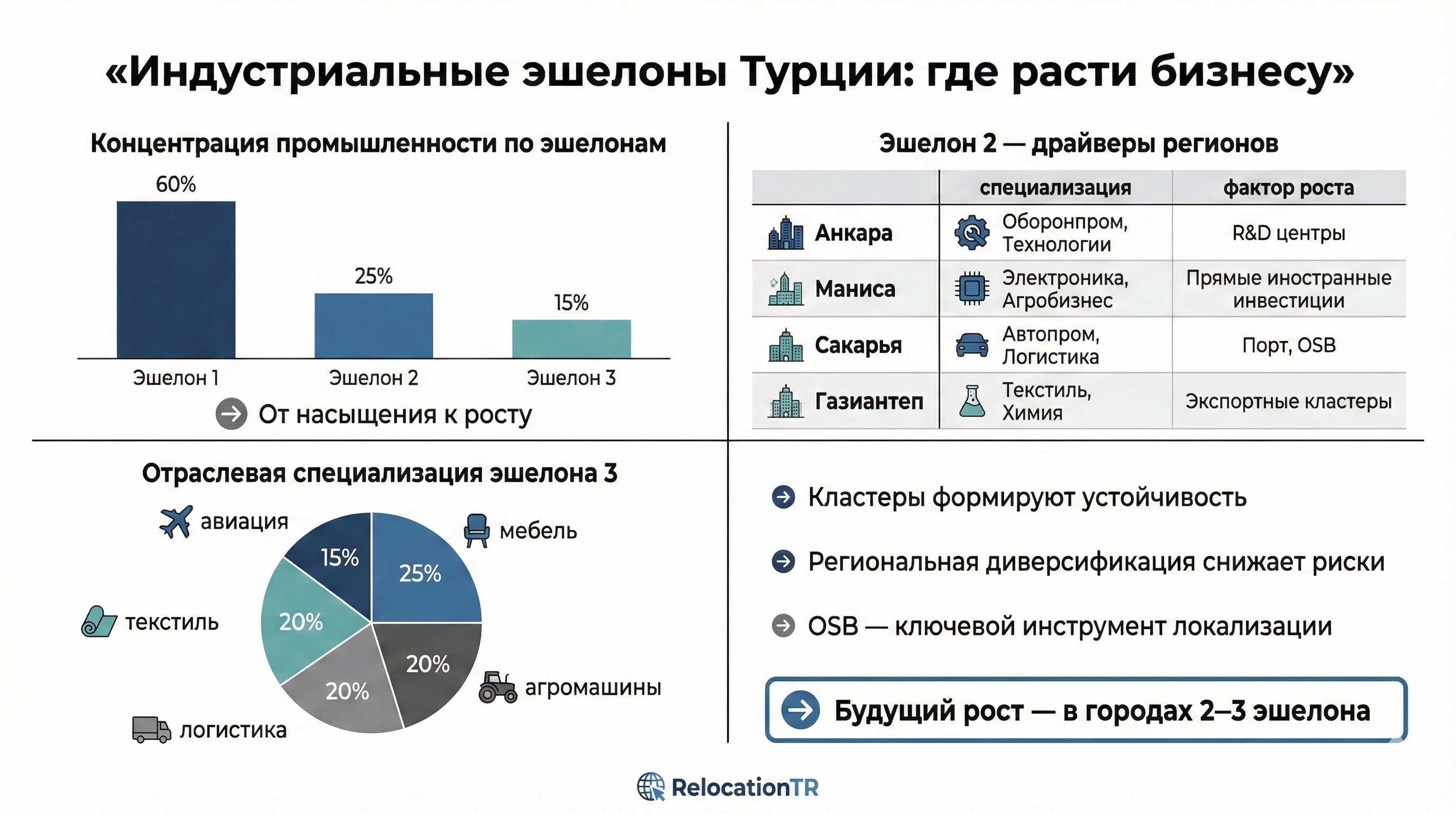
The industrial map of Türkiye is divided into three tiers, each serving its own distinct function in the economy.
Tier 1. The Industrial Backbone of Türkiye
This tier forms the foundation of national GDP. It concentrates not only production plants, but also:
decision-making centers,
finance and banking,
logistics and export infrastructure,
R&D and supply chain management.
Istanbul
The undisputed center of gravity of the Turkish economy.
It is not merely an industrial zone, but the "brain" of the country:
corporate headquarters,
the financial sector,
trade and logistics,
high-tech manufacturing and R&D.
For business, Istanbul provides access to capital and executive management, but it is not always the optimal site for manufacturing itself due to congestion and operating costs.
Kocaeli
The region with the highest industrial density in Türkiye.
Key industries:
automotive manufacturing,
petrochemicals,
metallurgy.
Its industrial output per capita is among the highest in the region.
Kocaeli is the heart of the country's heavy industry.
Bursa
A classic industrial powerhouse with a deep manufacturing culture.
Core strengths:
automotive assembly and auto components,
textiles,
machinery manufacturing.
The region is heavily export-oriented and tightly integrated into European supply chains.
Izmir
The industrial and logistics gateway of Türkiye.
Competitive advantages:
deep-water port infrastructure,
petrochemicals,
food processing,
machinery manufacturing,
an extensive network of OIZs (Organize Sanayi Bölgeleri - Organized Industrial Zones).
Izmir is frequently chosen by companies focused on export markets and maritime logistics.
Tier 2. Regional Growth Drivers
These are cities that relieve pressure on the saturated core and are emerging as new centers of industrial development.
Ankara
The capital is transforming into a technology and defense industry hub.
Focus areas:
defense industry,
electronics,
mechanical engineering.
Growth is driven by public procurement and state support for high-tech manufacturing.
Tekirdağ
Essentially the western manufacturing wing of Istanbul.
Well-developed sectors:
chemicals,
textiles,
plastics.
The region benefits from its proximity to the metropolis while offering significantly lower operational costs.
Sakarya
A fast-growing cluster for:
automotive manufacturing,
component parts production.
Frequently utilized as a production base for Tier-1 and Tier-2 suppliers.
Manisa
A center for electronics and home appliances (white goods).
It hosts major manufacturing giants (such as Vestel) that anchor an extensive ecosystem of suppliers around them.
Gaziantep
The most powerful industrial center in Anatolia.
Industry profile:
textiles,
food processing,
plastics.
A factory-city characterized by high entrepreneurial density and strong export orientation.
Tier 3. Specialized Regional Hubs
These cities form niche industry clusters, often featuring specialized expertise and lower barriers to entry.
Eskişehir — aerospace and advanced machinery
Kayseri — furniture and metal fabrication
Konya — agricultural machinery
Adana — textiles and chemicals
Mersin — port logistics and food processing
Denizli — traditional textile cluster
Key Takeaways for Business and Investors
The Turkish model of industrial concentration creates a dual effect:
Advantages
access to skilled talent,
mature infrastructure,
established supply chains in the core (Marmara region).
Disadvantages
logistical congestion,
rising operating costs,
seismic and environmental risks,
intense competition for resources.
Key Signal for Investors
Growth potential is shifting away from the congested core toward second- and third-tier cities, which offer:
lower entry barriers,
stronger support from regional authorities,
emerging industrial clusters.
RelocationTR Strategic Conclusion
Türkiye is not a single, homogeneous market, but a mosaic of industrial ecosystems.
Successful manufacturing localization begins not with selecting the country, but with choosing the right city and OIZ aligned with your sector, logistics requirements, and growth strategy.