
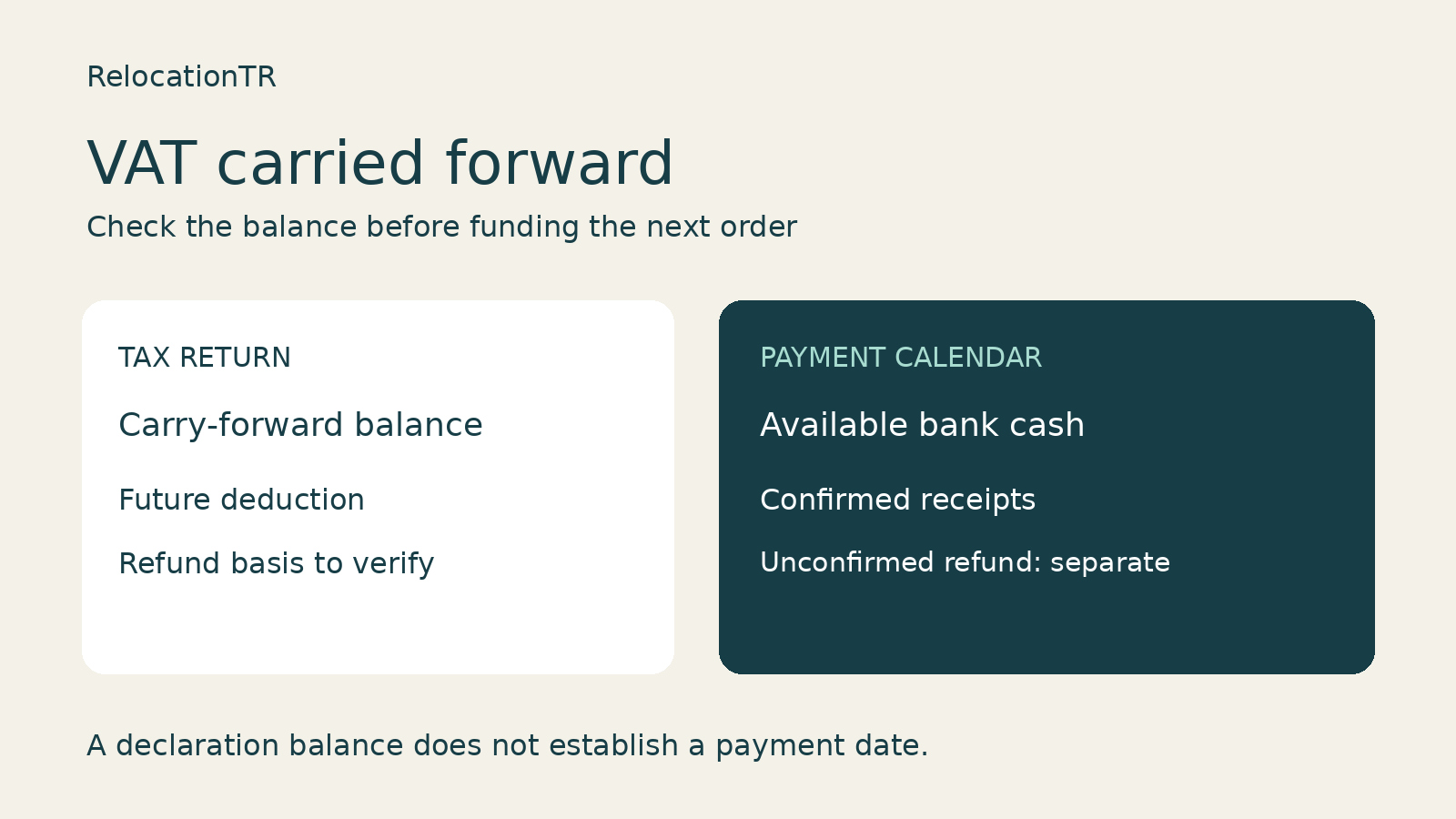
A company can pay VAT on purchases and report a substantial carry-forward balance while still needing cash for its next order. Before including an expected refund in the payment calendar, the owner needs to establish what that balance represents.
What devreden KDV means
Devreden KDV is VAT carried forward to subsequent tax periods. Under the general rule in Article 29(2) of Law 3065, where deductible input VAT exceeds output VAT on taxable transactions, the difference is carried forward rather than automatically paid out. The size of the balance does not itself establish refund entitlement.
The carry-forward may reduce VAT payable in later periods, subject to deduction rules. For cash planning, that is a potential reduction in a future tax payment, rather than a receipt into the bank account.
When a refund becomes relevant
A refund needs a separate statutory basis. Article 32, for example, covers specified exempt transactions, including qualifying exports. Entitlement depends on the transaction and the VAT attributable to it; the entire carry-forward cannot automatically be treated as refundable.
A cash refund and an offset against eligible liabilities affect liquidity differently. Establish which route is available, the required documents and the application's current status. Filing a VAT return, submitting a refund application and completing the refund are separate stages.
Case: the next purchase comes before the expected refund
Suppose a company buys materials, sells some output domestically and exports the rest. Its return shows VAT carried forward, while a new supplier requires an advance. Treating the entire balance as an imminent receipt could leave the company committed to a purchase without funding.
Ask the accountant to distinguish the balance available for future deduction from any amount attributable to refund-eligible transactions, and reconcile the refund calculation. Then check the documents and actual application status. For ordinary goods exports, GİB's guidance requires, among other items, an application, sales invoice and customs records, input VAT and export-related VAT lists, and a refund calculation. The package and review route depend on the applicable regime.
Build two cash scenarios: no refund before the supplier's advance falls due, and receipt at the expected time. Mark the unconfirmed date separately in the second scenario. If the first produces a shortfall, discuss the batch size, payment schedule or financing before accepting the commitment. A large declaration balance alone is no reason to reduce the cash reserve.
What to request from the accountant
Request one reconciliation showing the opening balance, input VAT, deduction used, closing carry-forward and a separate refund calculation. Attach the legal basis, period, filing confirmation, missing documents, responsible person and next status review date.
Track the claim deadline separately from the payment date. For Article 32 transactions, the statutory claim deadline is the end of the second calendar year following the transaction period; it does not promise payment by that date. Other refund grounds need their own rules checked. The owner's practical output is an identified funding source for the next purchase and evidence of the status of each expected amount.
Official sources
Law 3065, Articles 29 and 32; GİB, VAT General Application Communiqué, II/A-1.1.4.1 and IV/A-8.2. Reviewed on 6 November 2026. Check the particular transaction and current refund procedure with the accountant.