
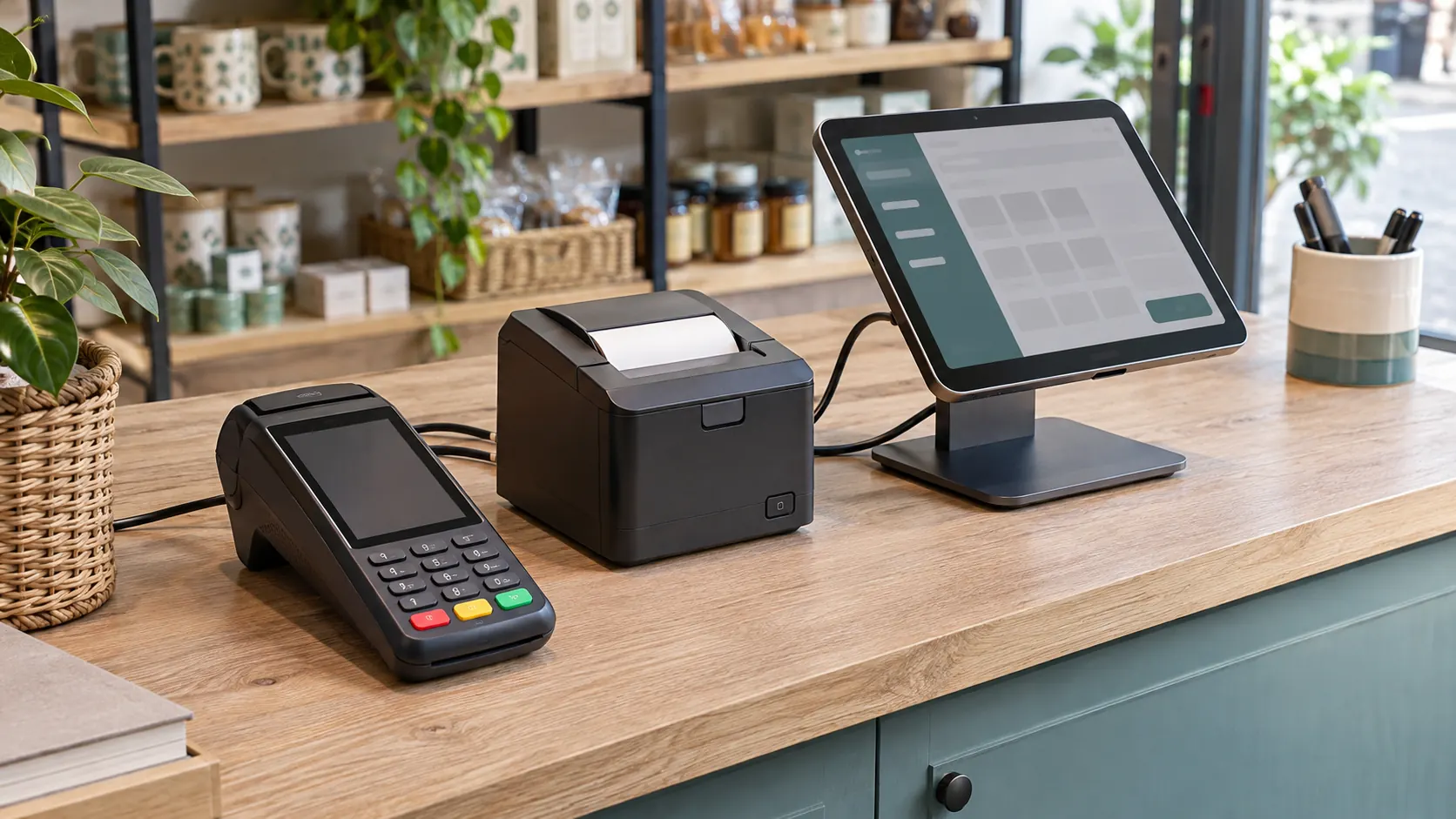
A Turkish POS offer needs more scrutiny than the card processing rate or the price of a terminal. The comparison also needs to cover fiscal equipment, sales software, integration, recurring service charges and the terms for changing providers.
For a shop, restaurant or new outlet, the useful outcome is a comparable cost over a defined period and a workable transition plan. The cheapest device may not produce the lowest total system cost.
Identify the three functions first
A quotation may use POS to describe different components. Ask for the specific device models, software, versions and organisations responsible for servicing them.
| Component | Function | What to establish |
|---|---|---|
| Bank EFT-POS terminal | Accepts card payments. | Who provides merchant acquiring, which charges apply and when the proceeds become available to the business. |
| YN ÖKC | A new-generation fiscal cash register used to document sales under the applicable fiscal-device regime. | Which model and configuration suit the activity, and whether the bank POS function is built in or connected separately. |
| Sales software | Manages orders, products, tables or other outlet operations. | What the licence includes, how it connects to the fiscal register and who handles updates. |
These are separate functions; a single device may combine several of them. Buying sales software does not, by itself, settle how sales must be documented for tax purposes.
Check the GİB requirements for the configuration
Article 8 of the current version of Tax Procedure Law General Communiqué No. 483 governs connections between fiscal registers, external equipment and sales software. For systems within the relevant requirements, the sales software connection to a YN ÖKC uses the GMP-3 protocol. However, Article 8(1) permits another protocol for certain bank EFT-POS connection configurations when its conditions are met. A blanket statement that every connection must use GMP-3 would be inaccurate.
Before ordering, establish the applicable fiscal-device regime with the accountant. Ask the software provider and authorised fiscal-register service to confirm the actual connection design. The written specification should identify models, versions, connection method and who is responsible for ensuring that sales are correctly documented by the register. Demonstrating a successful card payment does not test the whole sale process.
Put every offer into the same cost schedule
Compare the same number of outlets and devices, the same functions and the same period, such as the first year. Every price needs a charging unit: device, branch, user, month or year.
| Cost line | Question for the provider |
|---|---|
| Equipment and launch | Purchase or rental? Are installation, activation, configuration and training included? Who owns the equipment? |
| Licence and integration | One-off or recurring? Per register or per outlet? What is charged when a device is added or the software changes? |
| Support and updates | Which service hours are included? What do site visits, replacement devices and recovery from a failure cost? |
| Payment acceptance | Which processing rates and additional charges apply to the intended transaction mix? What are the refund and dispute terms? |
| Price changes | When can prices change, how is notice given, and does a promotional period end before the contract term? |
| Exit and migration | What notice, automatic renewal, termination charges, equipment returns and separate export or reconfiguration fees apply? |
Record whether each price includes KDV, Turkish VAT. The payment calendar needs the amount actually paid; the accountant assesses its tax treatment and any input deduction separately. Avoid counting an item twice when it is already included in a package.
A technical integration requirement and the price of a private service are separate matters. Ask the provider to identify the service, billing period and contractual basis for the charge. Mentioning GMP-3 does not establish that a particular annual fee is legally mandatory, or that it is unlawful.
Case: a new outlet and a lower processing rate
Suppose a company is opening its second outlet and receives an offer with a lower card processing rate. Its existing sales software will need connecting to new fiscal registers. It is not yet clear whether service is charged per branch or per device, or what leaving the current system will cost.
Obtain two comparable schedules: keeping the current system and moving to the new one. Include implementation, all recurring first-year payments and the cost of ending the old contract. Then show the first few months separately. An annual licence may need paying before the outlet opens and starts generating revenue.
Calculate processing charges using expected card turnover and the applicable terms. Put settlement timing into the cash calendar separately: payment authorisation and funds becoming available in the account are different stages. If delayed settlement creates a funding need, estimate its cost using the company's financing terms, separately from payment acceptance charges.
This comparison shows whether the processing savings cover the additional costs. It does not establish that switching is necessarily worthwhile or that the existing provider is overcharging.
Agree the transition before disconnecting the old system
Establish which data can be exported, in what format, for which period and at what cost. Check the transfer of the product catalogue, stock records and required reports. Ask the accountant which fiscal records must remain accessible and how they will be retained. Moving a product catalogue does not transfer the entire legally relevant archive.
Name one coordinator across the bank, software provider and fiscal-register service. The transition plan needs a date, a work window, terms for keeping the previous service available and an agreed response if launch fails. Do not assume parallel operation or a fallback arrangement is technically and fiscally acceptable without checking.
Acceptance criteria should cover a sale and its correct documentation, supported payment methods, cancellation or refund under the applicable procedure, shift closing and reconciliation of reports to bank receipts. Also establish who handles a connection failure and who pays for recovery. Disabling a required integration should not become an improvised workaround.
The owner's decision file
Before selecting a provider, obtain the system specification, a complete cost schedule with billing periods, settlement terms and a transition plan with acceptance criteria. Give each unresolved item an owner and response date. An offer is easier to assess when the business can see what it will pay at launch, during routine operation and on exit.
Official source
GİB: Tax Procedure Law General Communiqué No. 483, dated 30 September 2017, Official Gazette No. 30196, current consolidated version, Articles 8 and 9. This article distinguishes regulatory connection requirements from practical recommendations for comparing commercial offers. Checked on 11 November 2026.