
The practice of paying part of an employee's salary \"under the table\" while officially registering them at the minimum wage has long been perceived by businesses in Türkiye as an unwritten norm. Today, this model is rapidly transforming into a high-risk zone from both a tax and legal perspective.
While entrepreneurs are discussing the future minimum wage rate, the SGK (Sosyal Güvenlik Kurumu - the Social Security Institution) has already launched large-scale audits. The reason is straightforward: the state sees a systemic disparity between the official and actual earnings of workers—and is no longer willing to overlook it.
Why Audits Have Begun Right Now
The numbers speak for themselves:
- official minimum wage (gross / brüt): 26,005 TL,
- average wage according to SGK data: 47,676 TL.
This gap is a direct indicator of gray schemes.
Companies that have been reporting minimum wage for years despite their staff carrying a genuine market workload automatically deviate from the statistical baseline and fall under scrutiny.
The state is shifting its approach:
what was previously \"tolerated\" is now classified as a systemic violation.
Who Is in the Crosshairs of the SGK
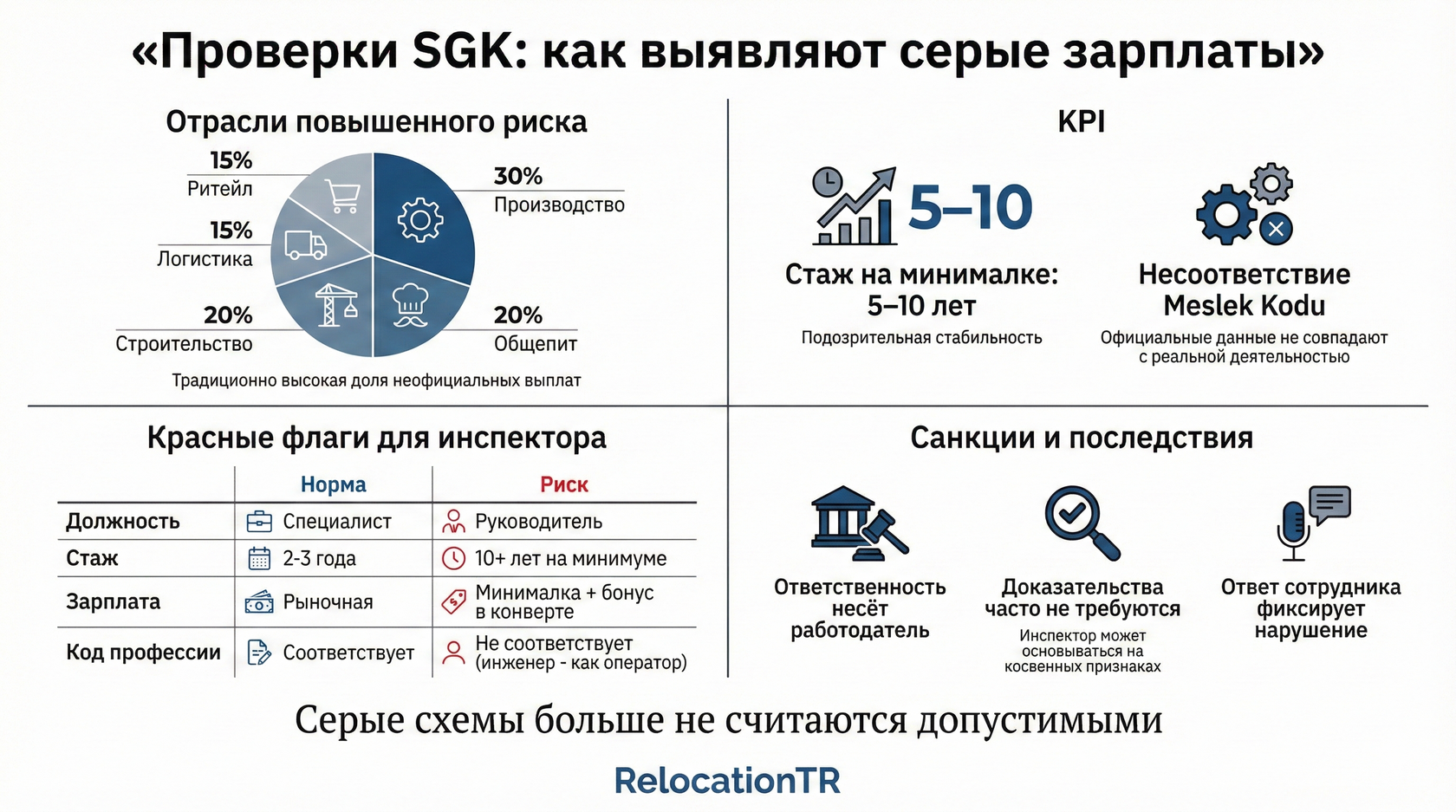
First and foremost, audits are targeting industries where the share of off-the-books payments is traditionally high:
- textiles and manufacturing enterprises,
- food service, hospitality, and consumer services,
- construction,
- logistics and retail trade.
High-Risk Red Flags for Inspectors
- employees registered at minimum wage for 5–10 years;
- job title (Meslek Kodu) does not correspond to the reported income level;
- a \"senior foreman\", \"head chef\", or \"manager\" is registered as an unskilled laborer or an intern.
Such discrepancies automatically trigger a high-risk profile for the company.
How an Audit Operates in Practice
Audits often begin without complicated document requests or technical evaluations.
An inspector asks an employee one direct question:
\"What salary do you actually receive?\"
If the worker responds:
\"On paper it is the minimum wage; the rest is paid in cash by hand\"
—this is sufficient to substantiate an infraction.
Additional corroborating evidence is frequently no longer required.
It is important to understand: the employee bears no liability, but the employer does.
The Consequences: Why This Can Prove Extremely Costly for Business
If a violation is confirmed, a chain of sanctions is triggered:
- retroactive recalculation of social security and pension contributions for up to 5 years,
- late-payment interest and penalties for each month of arrears,
- revocation of all SGK incentives and subsidies (teşvikler),
- risk of lawsuits filed by employees (recalculation of seniority tenure, statutory severance compensations),
- in severe cases—criminal consequences.
In practice, the business pays not only for the past \"savings\", but also for previous years accompanied by maximum statutory fines.
Urgent Action Items for Businesses: RelocationTR Recommendations
1. Audit Meslek Kodları (Occupation Codes)
The registered position must reflect the actual duties performed.
An engineer, foreman, or manager cannot be registered as an intern or unskilled personnel.
2. Completely Eliminate Cash-in-Hand Payments (elden ödeme)
Paying \"by hand\" is the primary audit trigger today.
Even an isolated instance creates exposure for the entire enterprise.
3. Reconcile Figures to the Last Lira
- bank disbursements,
- payroll registers,
- monthly SGK declarations
must align 100%.
4. Conduct an Internal Compliance Audit
It is far better to independently identify and remediate irregularities now than to face retroactive assessments covering five years alongside interest and fines.
RelocationTR Analytical Conclusion
The era of \"gray salaries\" in Türkiye is drawing to a rapid close.
The SGK is shifting from formalistic oversight to behavioral and statistical data modeling.
For business, this means one thing:
if your compensation model cannot withstand an inspector's simple question to an employee, it is dangerous.
The companies that succeed are those that:
- legitimize compensation across the board,
- bring job titles and salaries into full alignment,
- preemptively eliminate risks rather than reacting after the fact.
#sgk #salaries #taxesinturkey #compliance #risks