
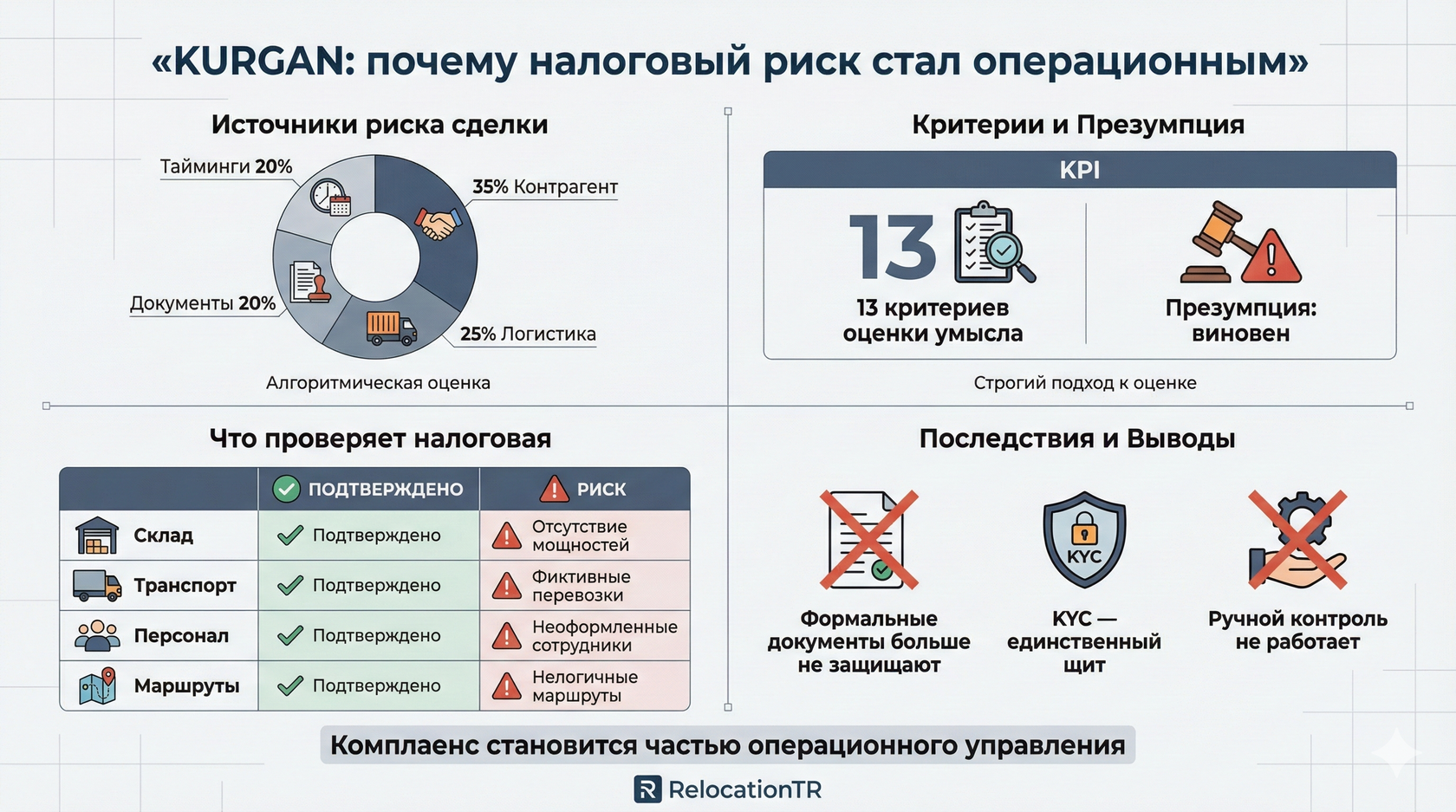
Starting October 1, 2025, the KURGAN (Kuruluş Gözetimli Analiz) system was officially launched in Türkiye. This is not merely a new IT tool for the tax administration—it is a paradigm shift in tax oversight.
While tax authorities previously evaluated a company as a whole, the focus has now shifted to each individual transaction.
Every transaction receives a digital risk score, and this score determines whether an audit will be initiated.
For business, this means:
there is no longer any such thing as a "default safe" transaction.
What Exactly Changed with the Launch of KURGAN
1. Oversight Has Become Transactional
KURGAN analyzes:
- financial flows,
- logistics,
- counterparty relationships,
- electronic signatures and timestamps,
- recurring transaction patterns.
- financial flows,
- logistics,
- counterparty relationships,
- electronic signatures and timestamps,
- recurring transaction patterns.
If the algorithm detects a discrepancy, it automatically triggers a chain of audits across the entire corporate structure and associated counterparties.
The Primary Threat: Presumption of Intentionality
The key and most dangerous innovation is the formal codification of the principle
"bilerek kullanma esas" (the principle of knowing use).
This means:
the tax authority assumes that you acted knowingly if you utilized documents or transactions involving a non-compliant counterparty.
If a supplier is deemed non-compliant or fraudulent:
- the tax authority defaults to presuming that you knew about it;
- the burden of proof rests entirely on the company;
- "we didn't know" is no longer a defense.
- the tax authority defaults to presuming that you knew about it;
- the burden of proof rests entirely on the company;
- "we didn't know" is no longer a defense.
- the tax authority defaults to presuming that you knew about it;
- the burden of proof rests entirely on the company;
- "we didn't know" is no longer a defense.
- reality of logistics
- (vehicle license plate numbers, waybills, delivery routes, time windows);
- alignment of transaction volume with the supplier's operational capacity
- (presence of warehouse facilities, staff, equipment);
- timestamps of electronic signatures (e-imza)
- — suspicious coincidences or anomalies;
- economic rationale of the transaction
- (pricing, margins, frequency of transactions);
- overlaps in addresses, IP addresses, accountants, and legal counsel.
How an Inspector Assesses "Intent": 13 Stringent Criteria
KURGAN utilizes a set of formalized indicators. Key criteria include:
- reality of logistics
- (vehicle license plate numbers, waybills, delivery routes, time windows);
- alignment of transaction volume with the supplier's operational capacity
- (presence of warehouse facilities, staff, equipment);
- timestamps of electronic signatures (e-imza)
- — suspicious coincidences or anomalies;
- economic rationale of the transaction
- (pricing, margins, frequency of transactions);
- overlaps in addresses, IP addresses, accountants, and legal counsel.
- reality of logistics
- (vehicle license plate numbers, waybills, delivery routes, time windows);
- alignment of transaction volume with the supplier's operational capacity
- (presence of warehouse facilities, staff, equipment);
- timestamps of electronic signatures (e-imza)
- — suspicious coincidences or anomalies;
- economic rationale of the transaction
- (pricing, margins, frequency of transactions);
- overlaps in addresses, IP addresses, accountants, and legal counsel.
Important:
just a few matches are sufficient for a transaction to receive a high risk score.
KYC Is No Longer a Formality—It Is Now the Sole Defense
While KYC verification was previously mandatory primarily for banks, it has now become mission-critical for every company.
Without demonstrable KYC, the tax authority can readily classify a transaction as sham or fictitious—even in the presence of invoices, processed payments, and physical goods.
What Businesses Must Do Right Now
1️⃣ Verify the "Physical Reality" of the Transaction
Ask a straightforward question:
is this counterparty genuinely capable of fulfilling its obligations?
- do they possess a warehouse?
- do they have personnel?
- do they have vehicles/transportation?
- does the transaction volume align with the scale of their business?
- do they possess a warehouse?
- do they have personnel?
- do they have vehicles/transportation?
- does the transaction volume align with the scale of their business?
2️⃣ Require Logistical Substantiation
Consignment notes, route sheets, and delivery confirmations now hold equal weight to tax invoices.
Without substantiated logistics, a transaction can easily be determined to be fictitious.
3️⃣ Record the Verification Itself
It is crucial not only to perform due diligence, but also to document that the verification was conducted prior to payment:
- screenshots,
- reports,
- checklists,
- internal evaluation reports.
- screenshots,
- reports,
- checklists,
- internal evaluation reports.
- screenshots,
- reports,
- checklists,
- internal evaluation reports.
- configurations in ERP and accounting systems,
- automated data reconciliation,
- anomaly alert systems.
- tax assessments and penalties;
- freezing of bank accounts;
- revocation of tax incentives;
- suspension of VAT refunds;
- allegations of complicity in tax fraud.
This will be your primary defense in a dispute.
4️⃣ Automate Oversight
Tracking 13 risk criteria manually is impossible.
The following are essential:
- configurations in ERP and accounting systems,
- automated data reconciliation,
- anomaly alert systems.
- configurations in ERP and accounting systems,
- automated data reconciliation,
- anomaly alert systems.
Consequences of Ignoring KURGAN for Businesses
- tax assessments and penalties;
- freezing of bank accounts;
- revocation of tax incentives;
- suspension of VAT refunds;
- allegations of complicity in tax fraud.
- tax assessments and penalties;
- freezing of bank accounts;
- revocation of tax incentives;
- suspension of VAT refunds;
- allegations of complicity in tax fraud.
All of this occurs without the tax authority needing to prove wrongful intent on your part.
RelocationTR Analytical Takeaway
KURGAN brings an end to conducting business based on "informal introductions" and "good faith trust."
Starting October 2025, trust must be verifiable.
Those who will prevail are companies that:
- implement rigorous KYC,
- exercise control over supply chains,
- automate compliance,
- think like a regulator rather than a bookkeeper.
- implement rigorous KYC,
- exercise control over supply chains,
- automate compliance,
- think like a regulator rather than a bookkeeper.
The rest risk facing not just a tax audit, but a systemic accusation of complicity.
#kurgan #taxesinturkiye #compliance #kyc #risks